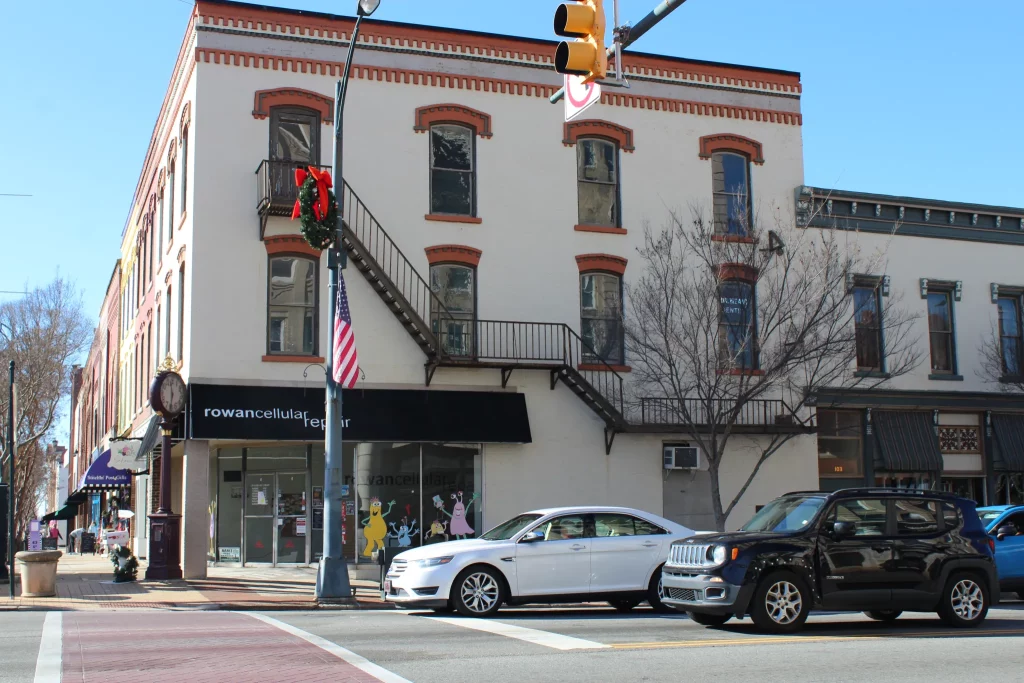
SALISBURY — The Historic Salisbury Foundation has been going through changes. After finalizing the sale of the Salisbury Train Depot to the city last week, the foundation purchased the building at 100 South Main Street and has finalized plans for moving its offices to the Utzman-Chambers house in the next year.
Last Friday, the City of Salisbury signed for the sale of the Depot, finalizing the $3.5 million sale of the building. A portion of the sale’s revenue went into the foundation’s revolving fund, which supports the purchase and renovation of historic properties in town. The city has yet to release its full plans for the station officially, but it begins the depot’s restoration project.
“It was never intended for us to keep the station for all those years, but we did. This discussion has been going on for a long time, but it was certainly nothing we took lightly as far as making that sale because there are a lot of different opinions on it. But, the bottom line came down to, how can we best fulfill our mission and how can we have the money to do so to invest in the community,” HSF Executive Director Kimberly Stieg said.
HSF bought the station in 1986 to preserve the legacy of the depot, which is one of the last remaining stations designed by architect Frank Milburn, who designed stations around the southeast. However, after the initial multimillion-dollar restoration project, maintenance and fees still cost over $60,000 annually. So, even those that appreciate the legacy of the depot recognize the benefit of selling to the city.
“It was never the intention to really keep it forever. We were just stewards of the property, essentially. It’s really a public building,” HSF Board President Edward Norvell said.
Following the depot’s sale, the foundation wasted no time in using these funds for restoration work. On Monday, the foundation purchased the building at 100 South Main, which is currently the Rowan Cellular Repair store. This property includes all three floors of the building along with the two floors above the current Graceful Beauty Lounge.
“It was very much a stars-aligning type thing for this property to become available,” Revolving Fund Property Manager Rachel Fink said.
HSF had tried to purchase the building roughly 10 to 15 years ago, but the owners did not want to sell at the time. Since the previous owner passed away, there was a list of entities to offer the building to before putting it on the market, which included HSF. So, the foundation purchased the building before it went to the public market.
This area of downtown is known as the burn district because during Stoneman’s march into Salisbury, the Union forces burned Confederate uniforms, documents and artillery in the center of the Square. The businesses around the square needed revitalization after the burning, which took place starting in late 1865.
The corner building was built and restored by the McNeely and Young family. Following the fire, the refurbished room on the third floor was known as Phoenix Hall because it rose from the ashes. Following the war, the building was a grocery and liquor store, and it was also the Davis and Wiley bank.
Fink expressed particular excitement about the property’s connection with Dr. Josephus Hall. Henrietta McNeely, Hall’s daughter, and her husband Julius McNeely owned the property after inheriting from Julius McNeely’s father. The other building included in the property sale was actually built by Hall in 1868.
“Even before the Civil War, he had actually retired from the medical scene and gotten into real estate. He had built some pretty significant buildings, but as far as I know this might be the only one left,” Fink said.
Prior to Rowan Cellular Repair, the building housed O.K. Wigs, of which some remnants could still be found in the building’s basement, which contained many wigs and mannequin heads.
The foundation plans to restore the building’s facade and structural concerns and then put the building back on the market, leaving the finishings and final use of the building up to the buyer. While still not formally designed, HSF is hoping to have the project done in the next year.
The Main and Innes corner of the building will be restored to the red brick, diagonal entrance that is flush with the neighboring buildings. There is also hope that the foundation will be able to remove the fire escape on the Innes Street side of the building.
“When it’s sold, then it will have our easements on it, which protects it and guarantees that it will be maintained and protected throughout the years,” HSF Board Member Ben Fisher said.
Part of the benefit of the foundation working on the property is that it ensures historical restoration practices rather than putting the burden on future developers initially.
“We feel like we can guarantee to make these buildings historically correct, now that we’re in the position to do so. So, that’s why this building specifically, we are interjecting ourselves,” Fisher said.
Additionally, HSF is moving its offices to the Utzman-Chambers house at 116 South Jackson Street, which is owned by the Maxwell Chambers trust. HSF is renting the building for their offices. The foundation is investing $90,000 into renovating the house to make it more functional for the HSF offices. They are also hoping to renovate the basement to be a small meeting space and the foundation’s archives.
“This is a very important house to the community, and we want to make sure that it’s well taken care of. We are happy to do it,” Stieg said.
HSF staff have already started moving to the new space, but the city gave them a year rent-free in the depot to move belongings and still function from the office until Utzman-Chambers is ready.
With the move, HSF is hoping to liquidate some of the Salisbury and depot archives collected over the years, so the foundation is holding an “estate sale.” The sale will run from Jan. 16 to 18 for the public, and foundation members will be invited earlier on Jan. 15.
“A 1907 Mission-style building, the furniture is going to be a little different than the 1814 Utzman-Chambers office,” Fink said. “We’re going to use those funds to furnish the Utzman-Chambers.”
With this recent sale, the revolving fund at the foundation has become one of the largest per capita revolving funds in the country, Chair of the Revolving Fund Committee Dylan Ellerbee estimates.
“There’s other very strong revolving funds in Charleston and Providence. Charlotte has a really strong one, but none of them are the size of Salisbury. It’s unfathomable that a city of our size, roughly 32,000 people, has what will be a $2.5-million liquid revolving fund,” Ellerbee said. “That’s going to go work for the people, and it immediately is with 100 South Main.”
Ellerbee continued to say that historically this is a turning point for Salisbury, as the city invests back into the depot and gives HSF the opportunity to work with even more properties.
“This is a pivotal, transformative moment for Salisbury. Not only because the city is putting close to $20 million into the station and preserving the station in perpetuity, which would have been very hard for us to continue to do at $60,000 a year just staying afloat, but also because we’re able to take that money in the revolving fund,” Ellerbee said. “We’re going to use it not only for important aesthetic, historical properties like 100 South Main but also for housing all throughout town.”